Does NEG work at very low temperatures only or does it work at ambient temperatures as well?

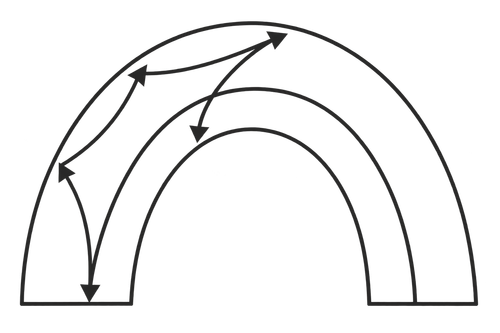
For the NEG effect to work, we need the following conditions being fulfilled: (a) All geometric features of our NEG-samples need to be large as compared to the de Broglie wavelength of the conduction electrons (which is around 1-10 nm). So that the electrons can be regarded as quasi-ballistic particles. (b) the mean free path of the conduction electrons needs to be comparable to the feature sizes of our samples (i.e. the mean free path length needs to be as long as or not much shorter than the feature sizes of our samples. So that our samples need to be roughly as small as the mean free path length of the electrons). If these conditions are fulfilled, then it can even be shown mathematically (solving the Liouville-equation) that the NEG-effect will inevitably occur. Our chosen material system AlGaAs/GaAs shows mean free electron path ways around 0,5 to 1 µm at low temperatures (< 50 K) only. At higher temperatures the mean free path length is reduced significantly due to electron collisions with phonons etc. That is why our AlGaAs/GaAs NEG-samples only operate reliably at temperatures < 50 K. At those temperatures we could enjoy minimum feature sizes of our NEG-elements to the tune of 500 nm, which makes fabrication of the geometries which we need much easier than smaller sizes. Other materials such as InGaAs/InP have been reported to exhibit mean free path lengths to the tune of 150-200 nm at ambient temperatures. That is why we have manufactured our second generation of NEG-elements using InGaAS/InP with minimum geometric feature sizes to the tune of 100 nm. For those NEG-elements we demonstrated the NEG-effect as well, however, although the effect is less pronounced because electron scattering increases significantly at room temperature. Therefore: Yes, if the right materials are chosen and the above mentioned conditions are met, the NEG-effect will occur also at ambient room temperature . A scientific paper with all our measurement data on this topic is expected to be published within the next few weeks.